
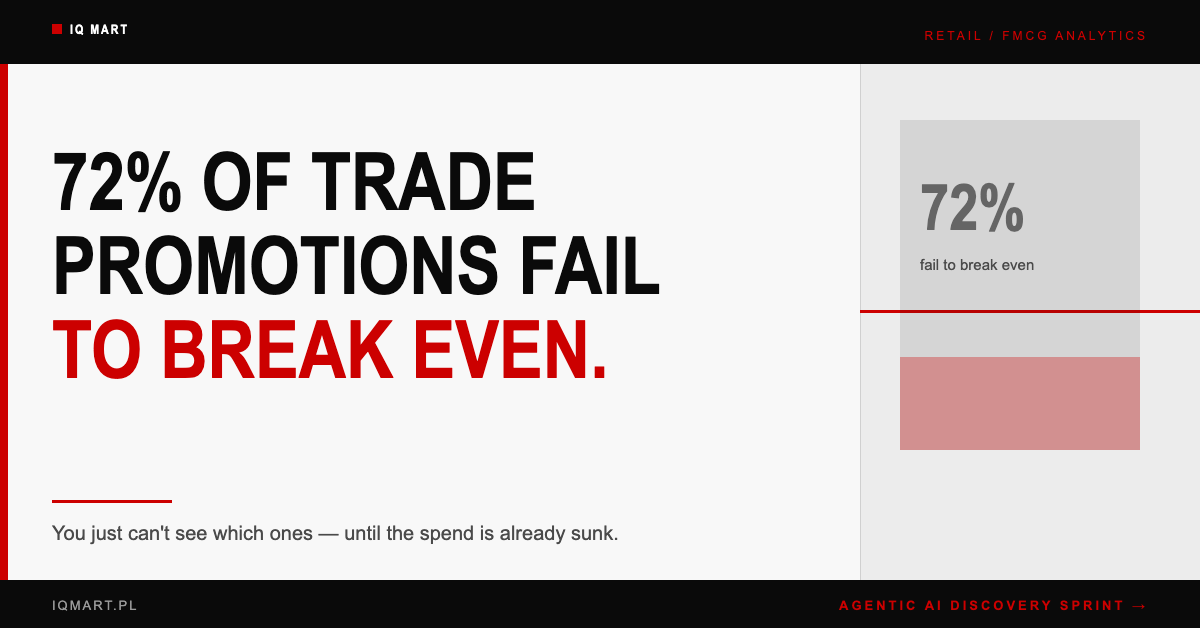
McKinsey’s CPG practice found that 72% of trade promotions fail to break even on gross margin once every cost is counted (McKinsey CPG Practice, “Cracking the Code on Trade Promotions”, 2023). Trade spend is typically the second-largest line item on a CPG P&L after cost of goods sold — 15–20% of revenue — and most of it goes to promotions nobody has properly checked. Not because nobody cares. Because by the time the post-event analysis is ready, three more promotions have already launched.
“72% of trade promotions fail to break even on gross margin when all costs are included.”
The Real Trade Promotion Problem Isn’t Measurement. It’s Timing.
Most category and RGM (revenue growth management) teams already measure promotion lift. Volume uplift, incremental revenue, baseline versus actual — the reporting exists. What is missing is a decision that happens while the promotion can still be changed.
A major beverage company found this the hard way: post-event analysis of trade spend took 3–4 weeks to complete, by which point the promotion had ended, the next quarter’s calendar was already locked, and the only thing the analysis could inform was next year’s plan — repeating the same allocation, including the underperforming activations, because there was no earlier moment to intervene (Progressive Grocer / CGT, “Trade Promotion Management,” 2024). The measurement was accurate. It just arrived after the decision it was supposed to inform had already been made twice more.
This is the shape of the problem across most CPG commercial organizations: promotion effectiveness is analyzed in arrears, on a cadence set by reporting cycles rather than by when a promotion could still be adjusted, paused, or reallocated.
Why Better Dashboards Don’t Fix This
The instinctive fix is a better trade promotion management (TPM) dashboard — faster BI, nicer visuals, more granular SKU-level lift. That is not nothing, but it treats the symptom. Progressive Grocer / CGT found that 67% of CPG manufacturers were still running promotion planning primarily off spreadsheets as of 2023 — and even the minority running a proper TPM system still analyze results after the promotion window closes, because the analysis pipeline itself is built as a monthly or quarterly reporting exercise, not a mid-flight decision tool.
The deeper issue is that nobody has named the actual decision a promotion effectiveness system should support: should this specific promotion, in week two of a six-week run, be adjusted, extended, or pulled — and who has the authority to make that call before the spend is fully sunk? Without naming that decision and its owner, more accurate reporting just produces a better-documented version of the same 72% failure rate — a cleaner autopsy, not a save.
BCG’s research on AI in consumer goods found that AI-driven promotion effectiveness analysis reduces ineffective promotional spend by 20–25%, and that FMCG companies deploying AI at scale across commercial operations outperform peers by 2–3x on EBIT margin improvement over three to five years (BCG, “AI in Consumer Goods,” 2023–2024). The gap between those companies and the 72% figure is not access to better data. It is whether the analysis reaches a decision-owner while the promotion is still running.
The IQ Mart Framework: Move the Decision Point, Not Just the Reporting Speed
Lorien Pratt’s decision intelligence framework describes this precisely as a decision-node problem: organizations invest in the model or the dashboard and leave the actual moment of human judgment — approve, adjust, pull — sitting in the same place it always was, three to four weeks after the fact. Fixing trade promotion effectiveness means moving that decision node earlier, into the promotion window itself, not making the after-the-fact report prettier.
In practice, this means an agent that tracks a live promotion against its expected lift curve day by day, flags the ones tracking below break-even by day 7–10 of a typical four-to-six-week run, and routes that flag to the person who actually owns the promotion budget for that account or category — with a clear, pre-agreed rule for what happens next: adjust the depth, extend it, or kill it. McKinsey’s CPG practice found that AI-driven post-event analytics improve future promotion ROI by 20–30% — but the larger, faster win is catching the current promotion before the spend is sunk, not just improving next year’s plan.
This is the same decision-first sequence that applies to any first AI agent use case in retail and FMCG — name the recurring decision and its owner before naming the technology. It also depends on the same governed-data foundation any agentic system needs: point-of-sale, shipment, and trade-spend data reconciled into one current, trusted version, the way the agentic data platform describes for AI agents generally. A promotion-tracking agent recommending a mid-flight pull is only as good as how current its sell-through and spend data actually are.
What Good Looks Like in Trade Promotion Management
Reallocating, not just cutting. A major beverage company used AI analysis to shift 15% of its trade budget away from underperforming promotions toward targeted activations, achieving a 2.5x return on the reallocated spend (McKinsey CPG Practice, 2023). The win was not spending less — it was moving the same budget to where it actually worked, based on a signal caught early enough to act on.
Category-level margin recovery. BCG reports that AI-driven assortment and promotion optimization has improved category gross margin by 3–5 percentage points for FMCG companies applying it at scale — a direct result of catching underperforming promotional mechanics (deep discounts with low incremental volume, for example) before they run their full course rather than after.
Faster analysis cycles changing behavior, not just reporting. Where CPG manufacturers have moved from the 3–4 week manual post-event cycle to near-real-time tracking, the behavioral change is not “prettier retrospective reports” — it is category managers actually calling an audible on week three of a promotion, something the old cadence made structurally impossible.
How to Start
If your trade promotion calendar is planned well but reviewed too late to matter, the fix is not a bigger TPM rollout. It is a scoped pilot around one decision.
- Name the mid-flight decision, not the end-of-quarter report. Pick one promotion type or one category where a week-two or week-three “adjust, extend, or pull” call would change the outcome, and name who currently has the authority to make that call.
- Check whether the data behind that decision is current enough to support it. Point-of-sale, shipment, and trade-spend data need to be reconciled daily or near-daily for a mid-flight signal to be trustworthy — not just accurate at quarter-end.
- Set the break-even trigger before the promotion launches. Decide, in advance, what lift-versus-cost threshold by what day of the promotion window triggers a review — so the decision is a pre-agreed rule, not a debate that starts only after the numbers already look bad.
The 72% figure is not a data problem or an analytics-maturity problem — most CPG organizations already have the reporting. It is a timing problem: the moment the analysis is ready is not the moment the promotion could still be changed. A useful question for the next commercial planning meeting: of the last ten promotions your team ran, how many were flagged as underperforming while they were still running — and how many were only flagged after they’d already ended? If the honest answer is “none while running,” that is where to start.
Ready to Find Where Your Trade Spend Is Actually Leaking?
The IQ Mart Agentic AI Discovery Sprint identifies the one recurring commercial decision in your promotion calendar where an AI agent creates measurable value first, and assesses the data readiness behind it — in a short, practical engagement, without a sales pitch.